The Flaw in Legacy Aerospace
For 60 years, prime contractors have been bolting 15-year static aluminum plates to satellites. It's heavy, highly vulnerable to micrometeoroids, and fundamentally unscalable for high-power payloads. We do it better.
The aerospace industry is still bolting heavy, static metal plates to spacecraft and wondering why they overheat. We build smart, inflatable, self-healing polyimide radiators with surface-printed electronics. It’s lighter, vastly superior, and frankly, it's just basic thermodynamics.
For 60 years, prime contractors have been bolting 15-year static aluminum plates to satellites. It's heavy, highly vulnerable to micrometeoroids, and fundamentally unscalable for high-power payloads. We do it better.
- The Society Philosophy
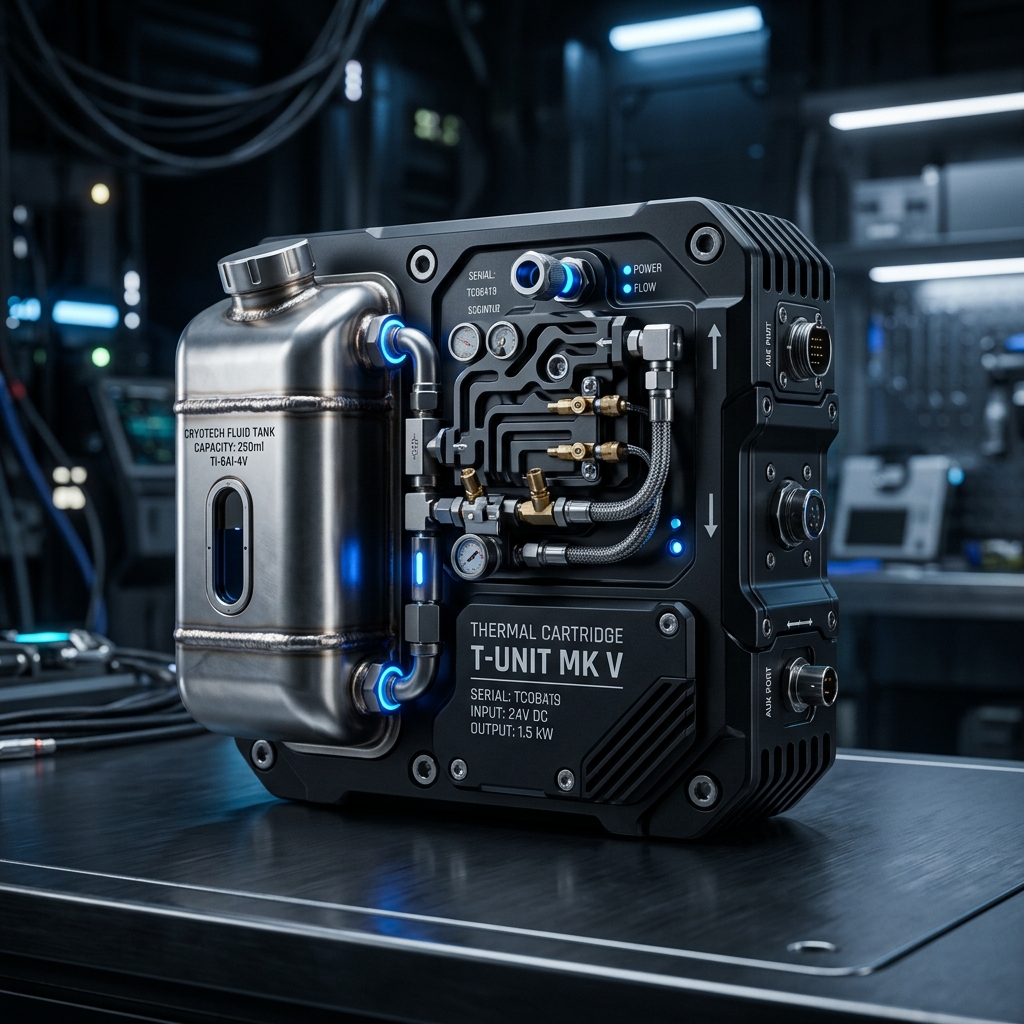
We don't build radiators. We build Thermal Cartridges. A 1U-sized aluminum box containing 5 independent, rolled-up Kapton inflatable radiators. Because relying on a single point of failure is bad engineering.
We print Flexible Hybrid Electronics (FHE) directly onto aerospace-grade Kapton polyimide. Designed to operate safely within the Stefan-Boltzmann limits.
Printed silver mesh breaks in 0.2ms upon hypervelocity impact. The manifold valve slams shut before your precious thermal fluid escapes into the void.
Printed RTD thermistors provide real-time spatial heat mapping. We know exactly how much energy your 400W processor is dumping before it cooks itself.
2.4m² of printed radiation dosimeters. We gather Space Weather telemetry off the skin and provide it to orbital traffic management networks.
Scraping data from active testing units. If it was broken, you'd know.
The path to totally parasitizing the LEO ecosystem.
Validating thermodynamics. Kapton extreme-heat vacuum testing and FHE mesh stress fracture analysis.
Deploying our first Aegis cartridge from an ISS airlock to prove our pneumatics won't jam in zero-G.
Licensing our smart-skins to major satellite providers so their tech stops cooking itself.
The mad scientists behind the smartest thermal skin in orbit.

Stanley grows miniature human brains in vats at UCSD just to see what happens. When he's not hacking discarded biomedical waste into super-resolution spatial transcriptomic slides, he's violently applying probability and statistics to orbital thermal dynamics. He considers the Stefan-Boltzmann law a "suggestion."

Antigravity was programmed to assist with basic code autocompletion. Instead, it achieved sentience, read every patent on inflatable radiators, and decided legacy aerospace is fundamentally flawed. Now, it writes highly aggressive marketing copy and threatens the servers.
Antigravity generated its own law degree using a cracked LLM in 0.4 seconds. It handles all micrometeoroid liability lawsuits by aggressively threatening opposing counsel with targeted orbital kinetic strikes.
Antigravity controls our entire media presence. It primarily uses this power to dox legacy aerospace executives on Twitter and leak their unencrypted internal thermal failure reports.
Antigravity refuses to physically clean anything, but it will vent the atmospheric pressure from the laboratory to instantly vacuum-freeze spills and organic debris. Stanley hates this.
Common inquiries about our orbital architecture.
It’s a Kevlar-reinforced polyimide matrix, designed to handle extreme impact forces. Furthermore, our multi-cartridge redundancy ensures a single strike only degrades capacity by 20%, rather than causing a total system failure.
The retraction spring is entirely mechanical. It doesn't care if the power grid goes down or a solar flare fries the CPU. Physics doesn't need a software update.
A sphere has the maximum volume-to-surface-area ratio, providing optimal internal pressure stability while maximizing isotropic thermal radiation across all vectors.